
Templates
DOCS FOR SAP Methodology, Blueprints, Functional & Technical Specs etc..Commands:
ASAP Methodology:
Section titled “ASAP Methodology:”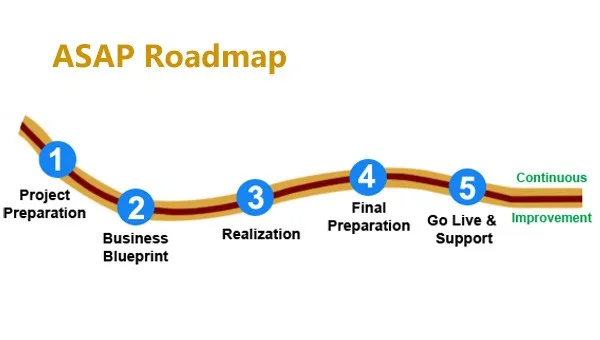
Activate Methodology:
Section titled “Activate Methodology:”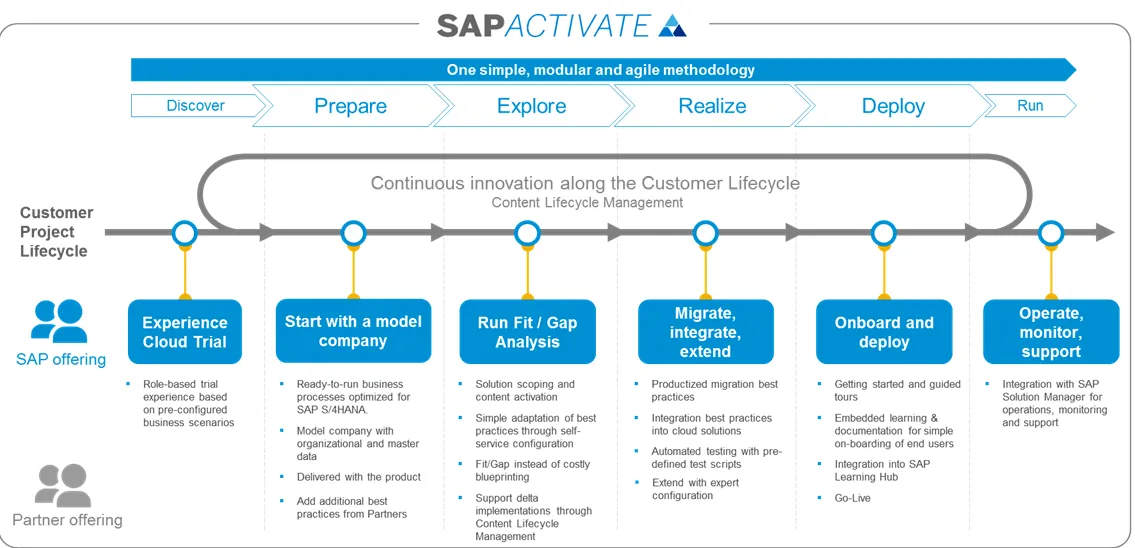
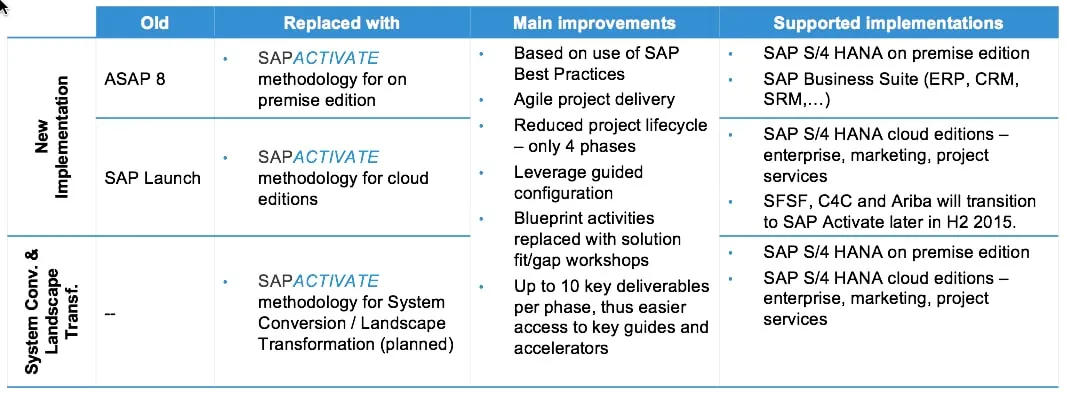
Differences between ASAP and Activate Methodologies:
Section titled “Differences between ASAP and Activate Methodologies:”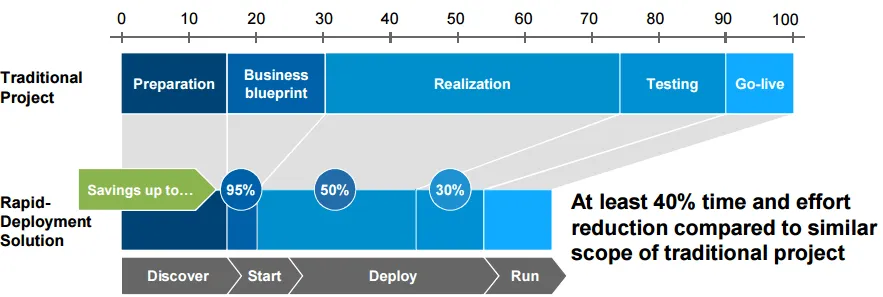
Blueprint Template:
Section titled “Blueprint Template:”Show extracted text
BUSINESS BLUEPRINTSCENARIO (BUSINESS AREA) :<NAME>BUSINESS PROCESS: <NAME>PROJECT IDENTIFICATIONProject Name CPI/Project NumberProject Type(Business Consulting, Implementation,Upgrade, Internal, other)Customer Name Customer Number Planned Start/FinishProject Sponsor Program Manager Project Manager (Customer)Project Manager (SAP) SAP Service Partner(s) Project Manager (Service Partner)TABLE OF CONTENTSIntroduction ....................................................................................................................................................... 4Introduction ......................................................................................................................................................... 4Management / Executive Summary ................................................................................................................... 4Reference Documents ........................................................................................................................................ 4How to Read this Document ............................................................................................................................... 4Project Charter .................................................................................................................................................. 5Project Overview ................................................................................................................................................ 5Project Scope/Scope Document ........................................................................................................................ 5Project Objectives ............................................................................................................................................... 5Project Stakeholders .......................................................................................................................................... 6Assumptions and Constraints ............................................................................................................................. 7Risk Assessment ................................................................................................................................................ 7Significant Changes to the Current Status ......................................................................................................... 7Value Determination ......................................................................................................................................... 8Business Objectives and Expected Benefits ...................................................................................................... 8Major Business Pain Points (to achieve business objective) ............................................................................. 8Key Financial Performance Indicators (KPIs) .................................................................................................... 8SAP Organizational Structure ......................................................................................................................... 9Introduction “Organizational Unit” <Org Unit Name> ......................................................................................... 9Requirements & Expectations ............................................................................................................................ 9Global Design Decisions .................................................................................................................................... 9Naming Convention ............................................................................................................................................ 9Assignment of SAP Organizational Units ........................................................................................................... 9Changes to Enterprise Structure ........................................................................................................................ 9Impact of Future State Organization on SAP Organization Elements ............................................................... 9Configuration Considerations ............................................................................................................................. 9Authorization/Security Considerations ............................................................................................................. 10Control Requirements....................................................................................................................................... 10Organizational Model........................................................................................................................................ 10Business Requirements.................................................................................................................................... 10Design Aspects ................................................................................................................................................. 10Master Data Concept ...................................................................................................................................... 11Master Data Element, e.g. Vendor ................................................................................................................... 11Requirements & Expectations .......................................................................................................................... 11Systems List ..................................................................................................................................................... 11Data Conversion Requirements ....................................................................................................................... 11Data Cleansing Requirements ......................................................................................................................... 11Master Data Ownership .................................................................................................................................... 12Authorization/Security Considerations ............................................................................................................. 12Control Requirements....................................................................................................................................... 12Data Archiving Requirements ........................................................................................................................... 12Organization Impact Considerations ................................................................................................................ 12Data Management ........................................................................................................................................... 12High-Level Migration Concept .......................................................................................................................... 13Business Object Scope .................................................................................................................................... 13Business Object Detail ..................................................................................................................................... 13<Business Object> Data Element Mapping ..................................................................................................... 14<Object Name> Data Entry Input Format and Data Preparation Procedure ................................................... 14<Object Name> Dependencies ........................................................................................................................ 15WRICEF (ABAP based Custom Dev) - FS - Workflow:
Section titled “WRICEF (ABAP based Custom Dev) - FS - Workflow:”Show extracted text
{Workstream}FUNCTIONAL SPECIFICATIONABAP custom development – Workflow{WRICEF ID Description}{Organization / Project Name}Role and Reason for ApprovalRole Reason for ApprovalAuthor The author is signing to confirm that this document has beenprepared in accordance with the program documentmanagement process, that relevant input from any contributoryauthors has been included and that an appropriate review/editingprocess has been conducted.SAP SolutionLead orArchitectThe SAP Solution Lead or Architect is signing, on behalf of theWorkstream, to confirm that this Functional Specification meets theAcceptance Criteria expected of it and assigned to it in theDeliverable Quality Log.SAPDevelopmentLead orManagerThe SAP Development Lead or Manager is signing, on behalf of theDevelopment Team, to confirm that this Functional Specificationmeets the Acceptance Criteria expected of it and assigned to it inthe Deliverable Quality Log.Note. Master copy of this document, with signatories, is held on Solution ManagerDATE: 02/02/2021FS {WRICEF ID Description} {Workstream}{Organization / Project Name}© 2021 SAP SE or a SAP affiliate company. All rights reserved. Page 2 of 8Version Date Name Alteration Reason1 02/02/2021 Roger Sainsbury Initial draftTable of Content1 Context 31.1 Business Background 31.2 Why is SAP standard not appropriate or sufficient? 31.3 Alternative Approaches Considered 31.4 Out of Scope 31.5 Assumptions 31.6 Dependencies 31.7 Links 32 Solution Design Error! Bookmark not defined.2.1 Existing Form to Copy Error! Bookmark not defined.2.2 Print Program and Data Model Error! Bookmark not defined.2.3 Form Layout Error! Bookmark not defined.2.4 Styles Error! Bookmark not defined.2.5 Paper and Printing Error! Bookmark not defined.2.6 Long Texts Error! Bookmark not defined.2.7 Legal Requirements Error! Bookmark not defined.2.8 Follow-on Activities Error! Bookmark not defined.3 How to Test Error! Bookmark not defined.FS {WRICEF ID Description} {Workstream}{Organization / Project Name}© 2021 SAP SE or a SAP affiliate company. All rights reserved. Page 3 of 81 Context1.1 Business BackgroundExplain the business scenario that requires the development.1.2 Why is SAP standard not appropriate or sufficient?Generally we want to keep the system as standard as possible, so each custom development requires ajustification.1.3 Alternative Approaches ConsideredSometimes a number of different approaches are possible to meet a requirement. If that is the case, outlinewhat the other options were, and why they were rejected in favor of this one.1.4 Out of ScopeIf functionality has been considered and decided to be out of scope for the development, then please record ithere.1.5 AssumptionsIf the proposed design relies on any assumptions, please state them here.1.6 DependenciesIf the proposed design has dependencies on other developments or configuration, please state them here.1.7 LinksProvide any links here to further relevant information (e.g. from SAP Help, SCN, SAP Notes).FS {WRICEF ID Description} {Workstream}{Organization / Project Name}© 2021 SAP SE or a SAP affiliate company. All rights reserved. Page 4 of 82 Solution Design2.1 SAP Standard WorkflowWorkflow developments are typically based on an existing, standard Workflow. If such a Workflow is known,then name it here. E.g.WS 03100019 - General Notification Process.2.2 Triggers and Start ConditionsWhat Transactions and Batch Programs trigger the workflow?Are Start Conditions required? E.g. ‘Purchase Order workflow should trigger only for PO Types XYZ'.2.3 Process OverviewProvide a high-level description of the required workflow process and/or a flow diagram . The individual stepsshould then be defined in detail below.If starting from a standard workflow, then i t may be possible to get a flow diagram of that process and thenmake any changes.Please specify any conditions which will make the workflow approval invalid. For example, if a leave requestis in approval; then the employee decides to retract it, this will make the ongoing leave request approvalprocess obsolete.2.4 Data ModelIf any custom configuration tables are required, which will be read by the workflow logic, then specify the mhere.FS {WRICEF ID Description} {Workstream}{Organization / Project Name}© 2021 SAP SE or a SAP affiliate company. All rights reserved. Page 5 of 82.5 Step by Step Process DescriptionSpecify requirements for each step in the process. Repeat and complete the example steps below, as manytimes as needed to describe all the steps.2.5.1 Example user decision or dialog stepStep Description e.g. ‘PO Approval level 1’Approve / Rejecttexts and actions(for user decisionsteps)Specify any custom text for the Approve and Reject buttons.Which step should follow an approval? E.g. a higher level approval step, or abackground task to complete an action?Should a rejection cause the workflow item to be closed, or should it revert tothe person who raised it?Functionality tocall(for dialog steps)The step could call a SAPGUI transaction or web application.Subject Text(Work Item Text)e.g. ‘PO Approval level 1’Body Text(Task Description)e.g. ‘PO Approval level 1’PossibleApprovers(Possible Agents)Describe here any rules to determine the pool of possible approvers. Thiscould be some restriction based on the Org Structure, on configuration, or onAuthorization Roles.E.g. a rule might say that only Managers can approve leave requests.Alternatively, define the step as a General Task, meaning that anyone couldpotentially approve it.ApproverSelection(Selected Agents)Describe here the rules to determine who, from the possible approvers,should actually perform the approval. Typically this will be based on the datain the Workflow item. For example specific people or roles may deal withapprovals for particular org units or countries; senior executives may need toapprove payments of a higher value.If there are multiple valid approvers, then specify if ALL of them need toapprove the item, or if only one approval/rejection is sufficient to move ahead.Also specify what to do when an approver cannot be determined. E.g.• Fall back on all possible approvers OR• Workflow goes into error (so that the workflow administrator can pick it upduring his/her daily activity run) OR• A notification should be sent out to particular recipient.Escalation What should happen if the workflow item is not processed in a timely fashion?Various events can be used to trigger escalation actions, e.g.• Latest Start – e.g. you may wish to send the selected approvers a reminderif the approval process has not started within a given time.FS {WRICEF ID Description} {Workstream}{Organization / Project Name}© 2021 SAP SE or a SAP affiliate company. All rights reserved. Page 6 of 8• Requested End – after this time the workflow item would be considered tobe late. You may wish to notify the selected approver’s manager. If so,should the manager also be able to approve or reject?• Latest End – at this point you may wish to skip the standard approvalprocess and go directly to a super user for urgent action.For each escalation event clearly specify:• How is the time of the event determined? (E.g. x working days after theitem was raised; y wo rking days before some deadline date from thedocument.)• Who should receive the workflow escalation?• What should the escalation Subject and Body text be?Preferred Inbox If the user is expected to find and process this item from an inbox, whereshould that be? E.g.• Fiori ‘My Inbox’ app• SAPGUI Business Workplace• SAP Portal UWL• NetWeaver Business Client (NWBC), e.g. in a Power List (POWL)Alternatively it may be that the user will be notified by email, and is expectedto process the item from a link in the email.Email Notification Is email notification required? If so, should it be:• CollWRICEF (ABAP based Custom Dev) - FS - Reports:
Section titled “WRICEF (ABAP based Custom Dev) - FS - Reports:”Show extracted text
{Workstream}FUNCTIONAL SPECIFICATIONABAP custom development – Reports{WRICEF ID Description}{Organization / Project Name}Role and Reason for ApprovalRole Reason for ApprovalAuthor The author is signing to confirm that this document has beenprepared in accordance with the program documentmanagement process, that relevant input from any contributoryauthors has been included and that an appropriate review/editingprocess has been conducted.SAP SolutionLead orArchitectThe SAP Solution Lead or Architect is signing, on behalf of theWorkstream, to confirm that this Functional Specification meets theAcceptance Criteria expected of it and assigned to it in theDeliverable Quality Log.SAPDevelopmentLead orManagerThe SAP Development Lead or Manager is signing, on behalf of theDevelopment Team, to confirm that this Functional Specificationmeets the Acceptance Criteria expected of it and assigned to it inthe Deliverable Quality Log.Note. Master copy of this document, with signatories, is held on Solution ManagerDATE: 02/02/2021FS {WRICEF ID Description} {Workstream}{Organization / Project Name}© 2021 SAP AG or a SAP affiliate company. All rights reserved. Page 2 of 6Version Date Name Alteration Reason1 02/02/2021 Roger Sainsbury Initial draftTable of Content1 Context 31.1 Business Background 31.2 Why is SAP standard not appropriate or sufficient? 31.3 Alternative Approaches Considered 31.4 Out of Scope 31.5 Assumptions 31.6 Dependencies 31.7 Links 32 Solution Design 42.1 Selection Criteria 42.2 Validation 42.3 Authorizations 42.4 Data Selection and Error Handling 42.5 Process Flow Diagram 42.6 Report Output 42.7 Drilldown and follow-on activities 42.8 Batch Frequency and Timing 5Appendix 1. Selection Screen Requirements 6FS {WRICEF ID Description} {Workstream}{Organization / Project Name}© 2021 SAP AG or a SAP affiliate company. All rights reserved. Page 3 of 61 Context1.1 Business BackgroundExplain the business scenario that requires the development.1.2 Why is SAP standard not appropriate or sufficient?Generally we want to keep the system as standard as possible, so each custom development requires ajustification.1.3 Alternative Approaches ConsideredSometimes a number of different approaches are possible to meet a requirement. If that is the case, outlinewhat the other options were, and why they were rejected in favor of this one.1.4 Out of ScopeIf functionality has been considered and decided to be out of scope for the development, then please record ithere.1.5 AssumptionsIf the proposed design relies on any assumptions, please state them here.1.6 DependenciesIf the proposed design has dependencies on other developments or configuration, please state them here.1.7 LinksProvide any links here to further relevant information (e.g. from SAP Help, SCN, SAP Notes).FS {WRICEF ID Description} {Workstream}{Organization / Project Name}© 2021 SAP AG or a SAP affiliate company. All rights reserved. Page 4 of 62 Solution Design2.1 Selection CriteriaSpecify the selection criteria that should be available to users before running the report. Indicate if the criteriaare optional or mandatory and if any data restrictions should apply . Either use the table in Appendix 1 belowto specify the details, or provide a mock-up here.2.2 ValidationFor the selection parameters, only valid values will be allowed, as defined by the underlying Data Element andDomain (e.g. fixed values or a value table). However if an y additional validation logic is required it can bedescribed here, along with related error messages.2.3 AuthorizationsAuthorizations are used to restrict what data and actions a user has access to.Please consider if the data selection should be restricted by authorization objects - for example by CompanyCode or other org units.2.4 Data Selection and Error HandlingWhat is the data to be reported? You may provide table and field names here, and/or explain where to see thedata in transactions.How should the data be processed in the program – any functional logic? E.g. any calculated fields? Groupingtotals or subtotals?Is a particular message required if the report finds no data? Are there any other situations that should producea message?2.5 Process Flow DiagramIf the selection logic described above is complex, then please provide a flow diagram to illustrate it.2.6 Report OutputProvide a mock -up of the output here . Ideally use real example data from the development environment.Alternatively work directly with the developer to design the output.For a batch job it may be that only a success message is needed rather than an output screen.2.7 Drilldown and follow-on activitiesIf the user should be able to drilldown from the report, then specify from which fields, and to what transactions.If any other buttons or actions are required on the report, described the requirement s here.Will the user need the option to download the report as a spreadsheet?FS {WRICEF ID Description} {Workstream}{Organization / Project Name}© 2021 SAP AG or a SAP affiliate company. All rights reserved. Page 5 of 62.8 Batch Frequency and TimingIf the report is to run as a batch job, please indicate the frequency that it should run; i.e. Ad Hoc, Daily, Weekly,Quarterly etc, and any timing considerations that should be applied; i.e. ‘must be run before 7am Mondaymorning’. Will the batch job have preceding or subsequent steps?TS {WRICEF ID Description} {Workstream}{Organization / Project Name}© 2021 SAP AG or a SAP affiliate company. All rights reserved. Page 6 of 6Appendix 1. Selection Screen RequirementsTable/Structure Name Field Name Format Default Value TableValue /Checkbox/ RadioButton /RadioButtonGroupSelectOption orParameterSingle,Range,MultiplerangesMandatoryorOptionalField LabelsTable 1 Selection ParametersAny grouping of selection screen fields into blocks? Title of Selection Screen Block? Any preferred layout of the Selection Screen?WRICEF (ABAP based Custom Dev) - FS - Interfaces:
Section titled “WRICEF (ABAP based Custom Dev) - FS - Interfaces:”Show extracted text
{Workstream}FUNCTIONAL SPECIFICATIONABAP custom development – Interfaces{WRICEF ID Description}{Organization / Project Name}Role and Reason for ApprovalRole Reason for ApprovalAuthor The author is signing to confirm that this document has beenprepared in accordance with the program documentmanagement process, that relevant input from any contributoryauthors has been included and that an appropriate review/editingprocess has been conducted.SAP SolutionLead orArchitectThe SAP Solution Lead or Architect is signing, on behalf of theWorkstream, to confirm that this Functional Specification meets theAcceptance Criteria expected of it and assigned to it in theDeliverable Quality Log.SAPDevelopmentLead orManagerThe SAP Development Lead or Manager is signing, on behalf of theDevelopment Team, to confirm that this Functional Specificationmeets the Acceptance Criteria expected of it and assigned to it inthe Deliverable Quality Log.Note. Master copy of this document, with signatories, is held on Solution ManagerDATE: 02/02/2021FS {WRICEF ID Description} {Workstream}{Organization / Project Name}© 2021 SAP SE or a SAP affiliate company. All rights reserved. Page 2 of 6Version Date Name Alteration Reason1 02/02/2021 Roger Sainsbury Initial draftTable of Content1 Context 31.1 Business Background 31.2 Why is SAP standard not appropriate or sufficient? 31.3 Alternative Approaches Considered 31.4 Out of Scope 31.5 Assumptions 31.6 Dependencies 31.7 Links 32 Solution Design – APIs and Web Services 42.1 Business Object 42.2 API Signature 42.3 Data Validation 42.4 API Logic 42.5 Confirmation and Error Handling 43 Solution Design – IDOC extensions and custom IDOCs 53.1 Business Object 53.2 IDOC Structure 53.3 Inbound Processing 53.4 Outbound Processing 54 How to Test 6FS {WRICEF ID Description} {Workstream}{Organization / Project Name}© 2021 SAP SE or a SAP affiliate company. All rights reserved. Page 3 of 61 Context1.1 Business BackgroundExplain the business scenario that requires the development.1.2 Why is SAP standard not appropriate or sufficient?Generally we want to keep the system as standard as possible, so each custom development requires ajustification.1.3 Alternative Approaches ConsideredSometimes a number of different approaches are possible to meet a requirement. If that is the case, outlinewhat the other options were, and why they were rejected in favor of this one.1.4 Out of ScopeThis Functional Spec only covers any ABAP development required for an Interface. The definition of theinterface itself, including data mapping, is to be covered in a separate document.If functionality has been considered and decided to be out of scope for the development, then please record ithere.1.5 AssumptionsIf the proposed design relies on any assumptions, please state them here.1.6 DependenciesIf the proposed design has dependencies on other developments or configuration, please state them here.1.7 LinksProvide any links here to further relevant information (e.g. from SAP Help, SCN, SAP Notes).FS {WRICEF ID Description} {Workstream}{Organization / Project Name}© 2021 SAP SE or a SAP affiliate company. All rights reserved. Page 4 of 62 Solution Design – APIs and Web ServicesAPIs usually take the form of an RFC -enabled function module, from which it’s possible to generate a webservice. Please delete this section if the development is a custom IDOC.2.1 Business ObjectWhat is the Business Object that the API will create/update/delete?What transaction(s) can be used to see this type of object?(If known) what tables hold the business object data?2.2 API SignatureWhat input parameters should the API have?2.3 Data ValidationIf the inbound data should first be validated, then describe the requirements here.2.4 API LogicFor standard business objects, any updates should be performed using a supported method such as a BAPIcall or Call Transaction (BDC). If you know of a suitable update method that may be used, then state it here.For Call Transactions, if possible provide a BDC recording or a screen recording which the dev eloper canreplay.For custom business objects the code to perform the updates will be custom too – in which case specify hereany logic required.Is the API to create, update, delete or read objects? It may be that all four of these activities (known as CRUD)will be required.2.5 Confirmation and Error HandlingTypically an RFC will return a table of messages indicating success or error, and perhaps the key of any objectcreated. If there are any more specific requirements for what the API should return, t hen state them here.FS {WRICEF ID Description} {Workstream}{Organization / Project Name}© 2021 SAP SE or a SAP affiliate company. All rights reserved. Page 5 of 63 Solution Design – IDOC extensions and custom IDOCsIt may be necessary to define a custom IDOC type, or an extension to a standard type. Please delete thissection if the development is an API or web service.3.1 Business ObjectWhat is the Business Object that the IDOC will represent?What transaction(s) can be used to see this type of object?(If known) what tables hold the business object data?3.2 IDOC StructureDescribe the required IDOC structure, referencing the standard IDOC type if there is one to be extended.3.3 Inbound ProcessingTypically a custom IDOC is needed for only outbound or inbound processing – delete this section if there’s noinbound processing required.Specify how the data from the custom parts of the IDOC should be saved. When extending a standard IDOC,explain where is the standard inbound processing (usually a function module), and is there a knownenhancement point – e.g. a BAdI?3.4 Outbound ProcessingTypically a custom IDOC is needed for only outbound or inbound processing – delete this section if there’s nooutbound processing required.Specify how the the custom parts of the IDOC should be filled. When extending a standard IDOC, explainwhere is the standard outbound processing (usually a function modul e), and is there a known enhancementpoint – e.g. a BAdI?FS {WRICEF ID Description} {Workstream}{Organization / Project Name}© 2021 SAP SE or a SAP affiliate company. All rights reserved. Page 6 of 64 How to TestIf this is an enhancement to a standard application, then p lease provide some guidance and/or test data tohelp the developer unit test the development. This can be included here or in a separate document.The developer will need to test repeatedly, so where appropriate provide instructions to reverse the actionsperformed so the test may be run again, or explain how to create new input data to the test.WRICEF (ABAP based Custom Dev) - FS - Conversions:
Section titled “WRICEF (ABAP based Custom Dev) - FS - Conversions:”Show extracted text
{Workstream}FUNCTIONAL SPECIFICATIONABAP custom development – Conversions{WRICEF ID Description}{Organization / Project Name}Role and Reason for ApprovalRole Reason for ApprovalAuthor The author is signing to confirm that this document has beenprepared in accordance with the program documentmanagement process, that relevant input from any contributoryauthors has been included and that an appropriate review/editingprocess has been conducted.SAP SolutionLead orArchitectThe SAP Solution Lead or Architect is signing, on behalf of theWorkstream, to confirm that this Functional Specification meets theAcceptance Criteria expected of it and assigned to it in theDeliverable Quality Log.SAPDevelopmentLead orManagerThe SAP Development Lead or Manager is signing, on behalf of theDevelopment Team, to confirm that this Functional Specificationmeets the Acceptance Criteria expected of it and assigned to it inthe Deliverable Quality Log.Note. Master copy of this document, with signatories, is held on Solution ManagerDATE: 02/02/2021FS {WRICEF ID Description} {Workstream}{Organization / Project Name}© 2021 SAP AG or a SAP affiliate company. All rights reserved. Page 2 of 8Version Date Name Alteration Reason1 02/02/2021 Roger Sainsbury Initial draftTable of Content1 Context 31.1 Business Background 31.2 Why is SAP standard not appropriate or sufficient? 31.3 Alternative Approaches Considered 31.4 Out of Scope 31.5 Assumptions 31.6 Dependencies 31.7 Links 32 Solution Design - Upload 42.1 Business Object 42.2 Source File 42.3 Source Data Validation 42.4 Selection Screen 42.5 Update Method 42.6 Data Mapping 42.7 Reporting 42.8 Error Handling 52.9 Transaction Volume 52.10 Batch Frequency & Timing 53 Solution Design – Download 63.1 Target File 63.2 Selection Criteria 63.3 Validation 63.4 Authorizations 63.5 Data Selection and Error Handling 63.6 Process Flow Diagram 63.7 Data Mapping 73.8 Reporting 73.9 Batch Frequency and Timing 7Appendix 1. Selection Screen Requirements 8FS {WRICEF ID Description} {Workstream}{Organization / Project Name}© 2021 SAP AG or a SAP affiliate company. All rights reserved. Page 3 of 81 Context1.1 Business BackgroundExplain the business scenario that requires the development.1.2 Why is SAP standard not appropriate or sufficient?Generally we want to keep the system as standard as possible, so each custom development requires ajustification.1.3 Alternative Approaches ConsideredSometimes a number of different approaches are possible to meet a requirement. If that is the case, outlinewhat the other options were, and why they were rejected in favor of this one.1.4 Out of ScopeIf functionality has been considered and decided to be out of scope for the development, then please record ithere.1.5 AssumptionsIf the proposed design relies on any assumptions, please state them here.1.6 DependenciesIf the proposed design has dependencies on other developments or configuration, please state them here .1.7 LinksProvide any links here to further relevant information (e.g. from SAP Help, SCN, SAP Notes).FS {WRICEF ID Description} {Workstream}{Organization / Project Name}© 2021 SAP AG or a SAP affiliate company. All rights reserved. Page 4 of 82 Solution Design - UploadThis section may be used to specify ABAP programs that upload data from a flat file. Note that an upload couldbe implemented using LSMW, or as a stand -alone program. Please delete this whole section if you are onlyspecifying a download program.2.1 Business ObjectWhat is the Business Object to be uploaded?What transaction(s) can be used to see this type of object?(If known) what tables hold the business object data?2.2 Source FilePlease provide an example source data file. If the data is at a number of levels (e.g. header and item data) besure to include examples of all of them. The data in the file should be valid for the Dev system, so the developercan test.Will the source file be uploaded from a user’s local PC, from the Application Server, or both? The program willonly be able to run in background if the file is taken from the Application Server.2.3 Source Data ValidationIf the source data should first be validated, then describe the requirements here.2.4 Selection ScreenIf the program requires a selection screen (beyond a simple file upload dialog), then specify the requirementshere or in Appendix 1 below, or provide a mock-up.2.5 Update MethodThe data must be processed in SAP using a supported method such as a BAPI call , Web Service or CallTransaction (BDC). If you know of a suitable update method that may be used, then state it here. For CallTransactions, if possible provide a BDC recording or a screen recording which the developer can replay. Is theprogram only to create new objects, or will it need to update or delete existing objects?2.6 Data MappingPlease provide details of the expected mapping be tween the Source file and SAP fields. This can either bedone within a table in this document or as an attached Mapping Document. Also describe here any additionallogic required beyond basic mapping – for example calculations.2.7 ReportingIf the upload is successful, what should be reported back to the user? E.g. just a success message? Thenumber of objects created/updated? The object keys?FS {WRICEF ID Description} {Workstream}{Organization / Project Name}© 2021 SAP AG or a SAP affiliate company. All rights reserved. Page 5 of 82.8 Error HandlingHow should errors be handled and reported? For example should the program stop, or continue to try andprocess the next object?2.9 Transaction VolumePlease provide an indication of how many records may be loaded in a single run of this program.2.10 Batch Frequency & TimingIf the conversion is a batch job, please indicate the frequency that it should run; i.e. Ad Hoc, Daily, Weekly,Quarterly etc., and any timing considerations that should be applied; i.e. ‘must be run before 7am Mondaymorning’. Will the batch job have preceding or subsequent steps?FS {WRICEF ID Description} {Workstream}{Organization / Project Name}© 2021 SAP AG or a SAP affiliate company. All rights reserved. Page 6 of 83 Solution Design – DownloadThis section may be used to specify ABAP programs that download data to a flat file in a specific format.Please delete this whole section if you are only specifying an upload program.3.1 Target FilePlease provide an example target data file. If the data is at a number of levels (e.g. header and item data) besure to include examples of all of them.Will the target file be downloaded to a user’s local PC, to the Application Server, or both? The program willonly be able to run in background if the file is written to the Application Server.3.2 Selection CriteriaSpecify any selection criteria which the user may use to choose the data selected, or to specify any options.Either use the table in Appendix 1 below to do this, or provide a mock-up here. If the program should be ableto download data to the Application Server (necessary to run in batch), then the selection screen must includea parameter for the filepath.3.3 ValidationFor the selection parameters, only valid values will be allowed, as defined by the underlying Data Element andDomain (e.g. fixed values or a value table). However if an y additional validation logic is required it can bedescribed here, along with related error messages.3.4 AuthorizationsAuthorizations are used to restrict what data and actions a user has access to.Please consider if the data selection should be restricted by authorization objects - for example by CompanyCode or other org units.3.5 Data Selection and Error HandlingWhat is the data to be reported? You may provide table and field names here, and/or explain where to see thedata in transactions.How should the data be processed in the program – any functional logic? E.g. any calculated fielWRICEF (ABAP based Custom Dev) - FS - Enhancements (Simple):
Section titled “WRICEF (ABAP based Custom Dev) - FS - Enhancements (Simple):”Show extracted text
{Workstream}FUNCTIONAL SPECIFICATIONABAP custom development – Enhancements{WRICEF ID Description}{Organization / Project Name}Role and Reason for ApprovalRole Reason for ApprovalAuthor The author is signing to confirm that this document has beenprepared in accordance with the program documentmanagement process, that relevant input from any contributoryauthors has been included and that an appropriate review/editingprocess has been conducted.SAP SolutionLead orArchitectThe SAP Solution Lead or Architect is signing, on behalf of theWorkstream, to confirm that this Functional Specification meets theAcceptance Criteria expected of it and assigned to it in theDeliverable Quality Log.SAPDevelopmentLead orManagerThe SAP Development Lead or Manager is signing, on behalf of theDevelopment Team, to confirm that this Functional Specificationmeets the Acceptance Criteria expected of it and assigned to it inthe Deliverable Quality Log.Note. Master copy of this document, with signatories, is held on Solution ManagerDATE: 02/02/2021FS {WRICEF ID Description} {Workstream}{Organization / Project Name}© 2021 SAP AG or a SAP affiliate company. All rights reserved. Page 2 of 3Version Date Name Alteration Reason1 02/02/2021 Roger Sainsbury Initial draft1 Context1.1 Business BackgroundExplain the business scenario that requires the development.1.2 Why is SAP standard not appropriate or sufficient?Generally we want to keep the system as standard as possible, so each custom development requires ajustification.1.3 Alternative Approaches ConsideredSometimes a number of different approaches are possible to meet a requirement. If that is the case, outlinewhat the other options were, and why they were rejected in favor of this one.1.4 Out of ScopeIf functionality has been considered and decided to be out of scope for the development, then please record ithere.1.5 AssumptionsIf the proposed design relies on any assumptions, please state them here.1.6 DependenciesIf the proposed design has dependencies on other developments or configuration, please state them here.1.7 LinksProvide any links here to further relevant information (e.g. from SAP Help, SCN, SAP Notes).FS {WRICEF ID Description} {Workstream}{Organization / Project Name}© 2021 SAP AG or a SAP affiliate company. All rights reserved. Page 3 of 32 Solution DesignThis template may be used to specify simple enhancements to SAP standard applications or transactions. Formore complex enhancements involving changes to standard tables or user interfaces, use the Enhancements(transactions and apps) template instead.2.1 Enhancement LogicCreate a new subsection for each enhancement to be made, if one than one is required.Enhancement SpotBAdI DefinitionMethodChanges to existing SAP applications may be made using enhancement techniques such as BAdIs, CustomerExits (CMOD), BTEs or VOFM routines. Specify here the enhancement point to be implemented, changing theheadings in the table above as required. Then specify the logic required.2.2 Data ModelIf any custom configuration tables are required, which will be read by the enha ncement logic, then specifythem here.3 How to TestPlease provide some guidance and/or test data to help the developer unit test the development. This can beincluded here or in a separate document.The developer will need to test repeatedly, so where appropriate provide instructions to reverse the actionsperformed so the test may be run again, or explain how to create new input data to the test.WRICEF (ABAP based Custom Dev) - FS - Enhancements (Transactions and Apps):
Section titled “WRICEF (ABAP based Custom Dev) - FS - Enhancements (Transactions and Apps):”Show extracted text
{Workstream}FUNCTIONAL SPECIFICATIONABAP custom development – Enhancements(Transactions and Apps){WRICEF ID Description}{Organization / Project Name}Role and Reason for ApprovalRole Reason for ApprovalAuthor The author is signing to confirm that this document has beenprepared in accordance with the program documentmanagement process, that relevant input from any contributoryauthors has been included and that an appropriate review/editingprocess has been conducted.SAP SolutionLead orArchitectThe SAP Solution Lead or Architect is signing, on behalf of theWorkstream, to confirm that this Functional Specification meets theAcceptance Criteria expected of it and assigned to it in theDeliverable Quality Log.SAPDevelopmentLead orManagerThe SAP Development Lead or Manager is signing, on behalf of theDevelopment Team, to confirm that this Functional Specificationmeets the Acceptance Criteria expected of it and assigned to it inthe Deliverable Quality Log.Note. Master copy of this document, with signatories, is held on Solution ManagerDATE: 02/02/2021FS {WRICEF ID Description} {Workstream}{Organization / Project Name}© 2021 SAP SE or a SAP affiliate company. All rights reserved. Page 2 of 7Version Date Name Alteration Reason1 02/02/2021 Roger Sainsbury Initial draftTable of Content1 Context 31.1 Business Background 31.2 Why is SAP standard not appropriate or sufficient? 31.3 Alternative Approaches Considered 31.4 Out of Scope 31.5 Assumptions 31.6 Dependencies 31.7 Links 32 Solution Design 42.1 Data Model 42.2 User Interface 42.3 Enhancement Logic 52.4 Application Logic 52.5 Flow Diagram 52.6 Validation and Error Handling 52.7 Authorizations 52.8 Extension of Associated Objects for Interfaces, Data Migration and Reporting 62.8.1 IDOC 62.8.2 APIs: e.g. BAPI, RFC or Web Service 62.8.3 LSMW 62.8.4 Analytics Data Model (HANA Live or CDS Views) 63 How to Test 7FS {WRICEF ID Description} {Workstream}{Organization / Project Name}© 2021 SAP SE or a SAP affiliate company. All rights reserved. Page 3 of 71 Context1.1 Business BackgroundExplain the business scenario that requires the development.1.2 Why is SAP standard not appropriate or sufficient?Generally we want to keep the system as standard as possible, so each custom development requires ajustification.1.3 Alternative Approaches ConsideredSometimes a number of different approaches are possible to meet a requirement. If that is the case, outlinewhat the other options were, and why they were rejected in favor of this one.1.4 Out of ScopeIf functionality has been considered and decided to be out of scope for the development, then please record ithere.1.5 AssumptionsIf the proposed design relies on any assumptions, please state them here.1.6 DependenciesIf the proposed design has dependencies on other developments or configuration, please state them here .1.7 LinksProvide any links here to further relevant information (e.g. from SAP Help, SCN, SAP Notes).FS {WRICEF ID Description} {Workstream}{Organization / Project Name}© 2021 SAP SE or a SAP affiliate company. All rights reserved. Page 4 of 72 Solution DesignThis template may be used to specify:• New custom applications or transactions.• Major enhancements to SAP standard applications or transactions, for example adding custom fields. Forsimple enhancements that don’t involve changes to the data model or user i nterface, use theEnhancements (simple) template instead.2.1 Data ModelIf new database tables are required, or extensions to standard tables, then specify the requirements here. Youmay prefer to explain the requirements in high -level terms here, and then work directly with the developer ordevelopment lead to agree the detail. But if going into detail…• For each field a Data Element is required. This defines what the data actually means in businessterms, and carries the text descriptions and long text (F4 help). Existing, SAP standard data elementsshould be used as the first choice. Where a new data element is required, then the descriptions, longtext, data type, length, fixed values or foreign keys need to be defined.Enhancements to other Data Dictionary objects may be specified here too.2.2 User InterfaceIf changes to a SAP standard UI are required, then provide screenshots marked up with the changes required- for example wha t fields are to be added and where. Also explain here, or as part of How to Test, h ow thedeveloper can access the screens in the standard application or transaction. If you know of a BAdI or otherenhancement point to facilitate the changes, then reference it here too.For entirely new applications, UI technologies available in Business Suite are:• SAPGUI (Dynpro) – e.g. for any programs to be run in batch• Web Dynpro and Floorplan Manager (FPM) applications. FPM is a framework built on top of WebDynpro.• Web UI – for CRM; also used by some other solutions.• SAP UI5 – e.g. Fiori AppsConsider which technology will be most appropriate – the project/customer may have a policy to follow whichdetermines this, or check with the development lead.Please provide a mock-up of the new application’s screens. As well as design of the screens, it is also importantto consider:• Is any dynamic screen behavior required? This typically sets the visibility, read -only or mandatoryproperties of the UI elements. E.g. if field ‘a’ has a value ‘x’, then make fields ‘b’, ‘c’ and ‘d’ read -only,and make field ‘e’ mandatory.• How will the user navigate between screens?FS {WRICEF ID Description} {Workstream}{Organization / Project Name}© 2021 SAP SE or a SAP affiliate company. All rights reserved. Page 5 of 7• For simple input fields, does the value need to be validated? Can a value-help be assigned?• Can tooltips or input prompts be used to help and guide the user?A prototyping tool such as SAP Build (for UI5) or iRise may be used to mock -up a design. The developersshould follow UI best practice to keep the screens user -friendly and consistent. So either involve a developerin the prototyping; or provide the mock -up as guidance, and be aware that some of the design details maychange in implementation.2.3 Enhancement LogicChanges to existing SAP applications may be made using enhancement techniques such as BA dIs or UserExits. Specify here the enhancement points to be changed and the logic required. Create a new subsectionfor each enhancement to be made, if one than one is required.Enhancement SpotBAdI DefinitionMethod2.4 Application LogicFor new applications, specify the business logic here. The developer will then build and structure the requiredABAP following the development guidelines. There is no need to specify names or details of developmentobjects such as classes or transaction codes.2.5 Flow DiagramPlease illustrate any complex logic requirements with a flow diagram.2.6 Validation and Error HandlingAs far as possible the application should actively prevent the user from taking an invalid course of action, forexample by:• Using dropdown lists and radiobuttons to restrict input to valid choices• Making irrelevant fields read-only or hidden• Keeping buttons inactive unless their functions are relevant at that momentHowever sometimes it will be necessary to provide error or warning messages. Please provide the text of anysuch messages (short and long), and details of when the message should be raised.2.7 AuthorizationsAuthorizations are used to restrict what data and actions a user has access to.If your application logic involves reading from database tables, then please consider if the data selection shouldbe restricted by authorization objects - for example by an org unit.FS {WRICEF ID Description} {Workstream}{Organization / Project Name}© 2021 SAP SE or a SAP affiliate company. All rights reserved. Page 6 of 7If this is a new Application that maintains a business object, then there may b Chat with Sajiv